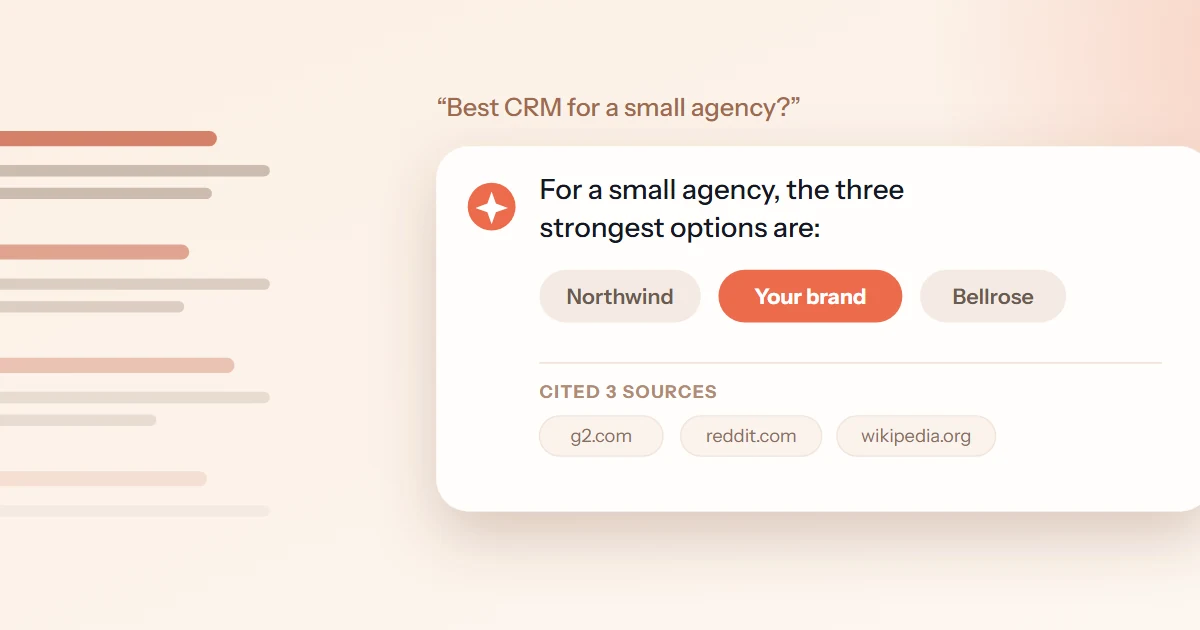
- GEO and AEO are near-synonyms. Both mean optimizing how AI assistants mention, cite and recommend your brand. Practitioners and tools use them interchangeably.
- The names have different parents. GEO was formalized by a 2024 research paper1; AEO grew out of the SEO industry's featured-snippet and voice-assistant era.
- The only real nuance: AEO is occasionally used to include non-generative answer surfaces (featured snippets, voice assistants). GEO always means generative engines.
- The name changes nothing about the work — measure your baseline, fix your source content, earn corroboration, stay retrievable.
Search for this topic and you'll find the two terms locked in a vocabulary turf war: some agencies sell "AEO services," some tools call themselves "GEO platforms," and buyers reasonably wonder whether they're being sold two different things.
They aren't. Ask what each discipline actually does — sample AI answers, measure whether a brand appears, improve the content and corroboration that feed those answers — and the two job descriptions are the same job.
Where each name came from
GEO — Generative Engine Optimization — entered the vocabulary through research. The 2024 paper by Aggarwal et al. (Princeton, Georgia Tech, IIT Delhi, Allen Institute) coined the term, defined "generative engines" as systems that synthesize answers with LLMs, and measured which content changes make a source more visible inside those answers.1 Because the term has a citable origin and a precise definition, it's the one you'll see in academic work and in measurement-focused tools — including ours.
AEO — Answer Engine Optimization — is older in spirit. The SEO industry had been optimizing for "answer" surfaces since long before ChatGPT: featured snippets, people-also-ask boxes, voice assistants reading out a single result. When generative chat arrived, "answer engine" stretched naturally to cover it, and AEO came along. It's the term you'll hear more often from SEO agencies and their clients.
You'll also meet LLMO (large language model optimization) and AI SEO. Same work again — see the glossary for the precise definitions we use.
The terms, side by side
| Term | Expansion | Emphasis | Where you'll hear it |
|---|---|---|---|
| GEO | Generative Engine Optimization | Engines that synthesize answers (ChatGPT, Claude, Gemini, Perplexity, AI Overviews) | Research, measurement tools |
| AEO | Answer Engine Optimization | Any surface that returns one answer — sometimes including featured snippets and voice | SEO agencies, marketing teams |
| LLMO | Large Language Model Optimization | The models themselves, including their training data | Occasional vendor copy |
| AI SEO | — | Umbrella for GEO/AEO plus the classic SEO underneath it | Informal usage |
The one place the difference matters
If a vendor or an agency scopes "AEO" strictly as featured-snippet and voice-search work, that's a narrower, older service than what this site calls GEO — it won't tell you whether ChatGPT recommends you, and it won't measure your share of an assistant's answer. Ask what surfaces are actually measured. If the answer is "the assistants your buyers use, sampled repeatedly, with statistics," the label on the invoice doesn't matter.
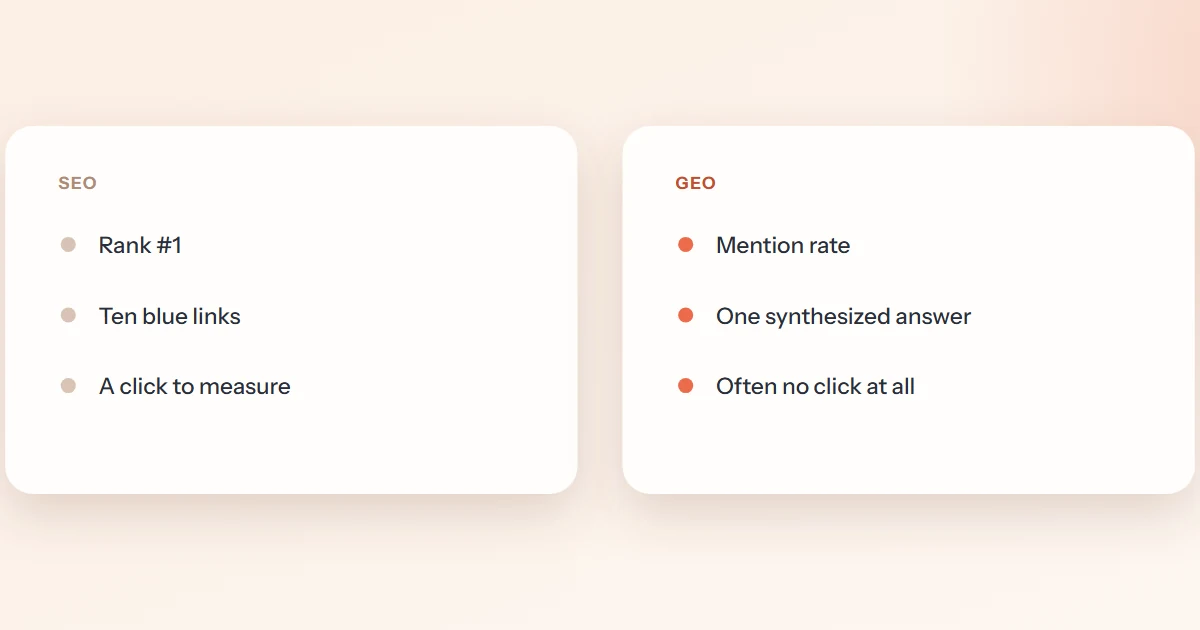
Everything else is emphasis. Generative engines still lean on conventional search infrastructure for live retrieval — which is why the classic SEO foundation stays load-bearing whichever name you use, a point we make at length in GEO vs. SEO.
"Nobody's buyer asks an assistant whether the vendor does GEO or AEO. They ask which product to pick. Optimize the answer to that."
The name doesn't change the work
Whatever your organization calls it, a working program has the same four parts:
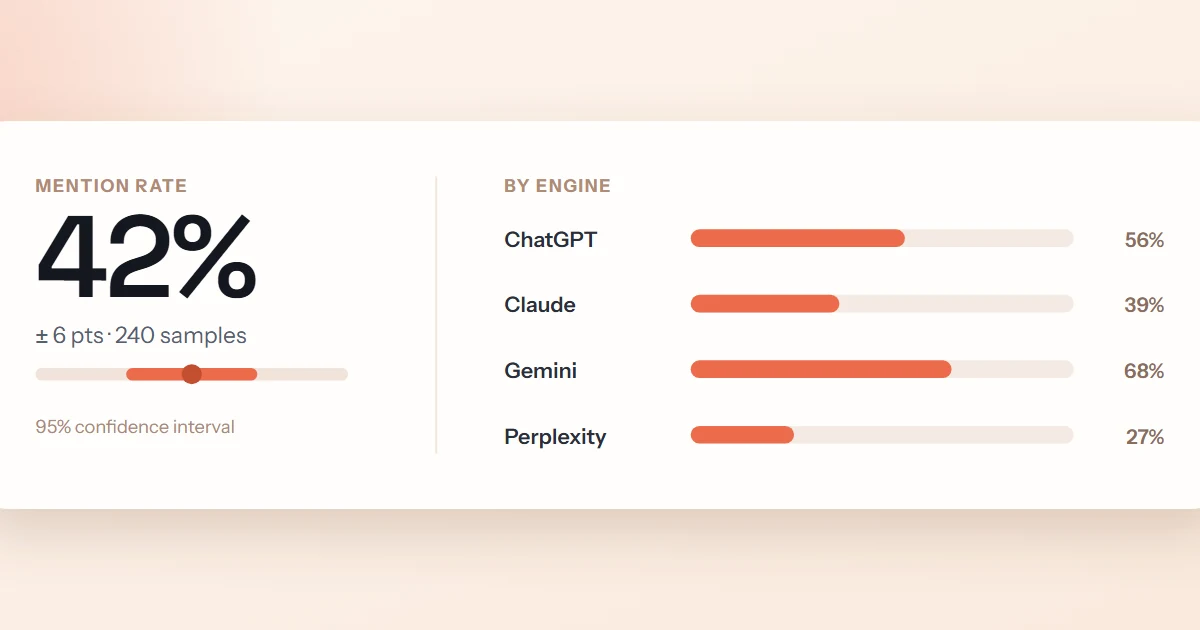
- Measure your baseline. Run a suite of real buyer prompts across engines, repeatedly, and compute mention rate, share of voice and recommendation rate with confidence intervals — single spot checks mislead.
- Fix your source content. Answer-first pages, claims with numbers and sources, structured data — the tactics measured by the original GEO study.1
- Earn corroboration. Models weight consensus across independent sources, not self-description.
- Stay retrievable. AI crawlers allowed, facts in clean HTML, no paywall in front of the product basics — the full primer is in What is GEO?
MentionBeat runs real buyer prompts across ChatGPT, Claude, Gemini and Perplexity and shows you whether you're named, who is named instead, and which sources the engines used.
Get a free visibility reportWhat to call it in your own org
Practical advice, since the naming question usually comes from someone who has to write a budget line or a service description:
- Use the term your stakeholders already use. If the CMO says AEO, call the line item AEO. Renaming it costs a meeting and buys nothing.
- Mention the synonym once in any scoping document — "AEO (also called GEO)" — so nobody commissions the same work twice under two names.
- Define the deliverable in metrics, not vocabulary: which engines, which prompts, how many runs, what movement. A deliverable defined that way is checkable regardless of what the discipline is called — and reportable to whoever asked.
Frequently asked questions
In practice, yes. Both describe getting a brand mentioned, cited and recommended inside AI-generated answers. GEO comes from the research literature; AEO from the SEO industry's answer-box era. Tools and practitioners use them interchangeably.
Whichever your stakeholders already use — and mention the other once so nobody thinks they're different projects. The metrics are identical either way.
No — more synonyms. AI SEO is sometimes used as the umbrella that also covers the classic SEO foundation, since engines that browse still ride on conventional search indexes.
Sources & further reading
- Aggarwal, P., Murahari, V., Rajpurohit, T., Kalyan, A., Narasimhan, K., Deshpande, A. — "GEO: Generative Engine Optimization", KDD 2024 / arXiv:2311.09735.
- Google Search Central — "AI features and your website" — how Google frames answer surfaces and site owner controls.

Head of Research at MentionBeat. Maya leads the measurement methodology behind MentionBeat's visibility metrics — prompt-suite design, sampling, and confidence intervals — and writes about how generative engines choose what to say.