Claude brand tracking is the measurement layer that reports how often Claude names your brand, and whether it recommends you or merely lists you. Claude increasingly sits inside the tools people already work in, which makes what it says about your category worth measuring rather than guessing at.
An engine named after a surface it did not measure is a fabricated result with extra steps, so here is the precise scope before anything else. For Claude, we measure Anthropic's model with its web-search tool enabled.
| What it means here | |
|---|---|
| Direct evidence | The answers come from Anthropic's own model using its own web-search tool. That is direct evidence for this model's grounded behaviour. |
| Not claimed | As with any API-measured assistant, this is the model surface, not the consumer chat product. It is the closest measurable proxy, and it is labelled that way rather than implied to be the app. |
| How a run works | We call Anthropic's API with web search on, using your category questions, repeatedly. Raw answers are stored so every rate is traceable to the text behind it. |
Claude tracking is also known as Claude mention monitoring or Claude visibility tracking. The same direct-versus-proxy distinction is applied to every engine we support, and it is written into the published methodology rather than left to a sales conversation.
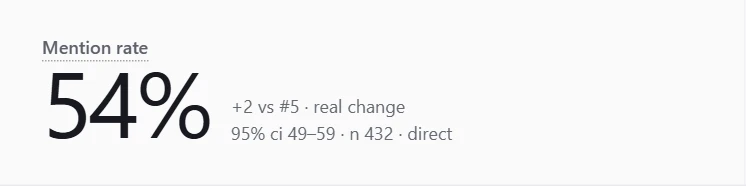
Rates, not screenshots — each with a 95% confidence interval and the number of answers behind it, so you can tell a real change from a noisy week.
| Metric | The question it answers |
|---|---|
| Mention rate | Of the answers to your category's questions, how many name you at all |
| Share of voice | Of every brand named across those answers, what fraction is you |
| Recommendation rate | How often you are actively endorsed rather than listed in passing |
| Cited sources | Which domains Claude leaned on — yours, and everyone else's |
| Accuracy flags | Anything Claude said about you that is factually wrong |
One reading is not a trend. Runs repeat on a schedule so the comparison is against your own history, not against a screenshot someone took once.
Because they disagree. Different models retrieve differently and weigh sources differently, so the brand line-up for the same question is often not the same. Averaging them into one score hides exactly the difference you would want to act on.
Both, depending on the question. That is why grounded and parametric answers are classified and reported separately — only the grounded half can respond to something you published this quarter.
An endorsement or a top-of-list placement, as opposed to being mentioned in passing. The distinction is applied by a calibrated judge against a written rubric, and scored consistently across engines so the comparison holds.
The editorial companion to this page — how Claude chooses what to say, and what earns a mention.
Claude is one surface. The full tracking layer runs your suite across all of them and compares.
The sampling, the calibrated judge, the statistics — and the six-point bar to hold any tool to.
Run your category's real buyer questions and get a rate with an interval — not a screenshot.