- Good GEO examples aren't screenshots of one lucky answer — they're tactics with observable footprints: pages, files and deals you can inspect yourself.
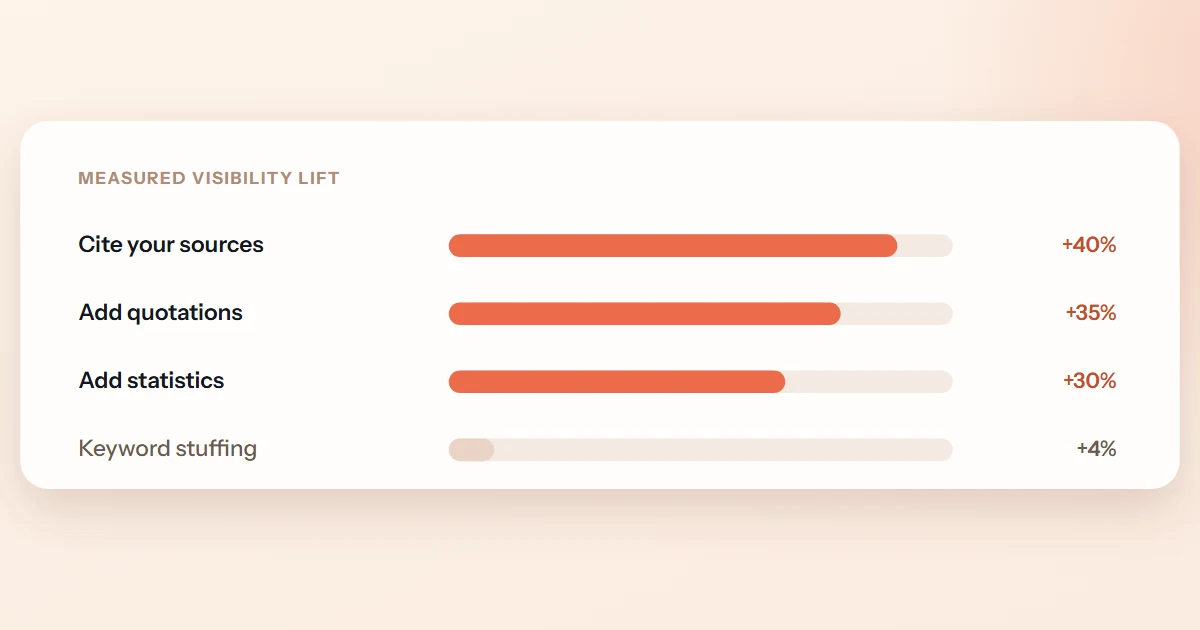
- The best-measured tactics come from the GEO study: citations, quotations and statistics lifted source visibility by up to ~40%; keyword stuffing did roughly nothing.1
- Engines put real weight on community and reference corroboration — Google licenses Reddit content for reported $60M a year,2 and Reddit and Wikipedia sit among the most-cited domains in AI answers.3
- No invented before/after numbers here. Where a tactic's effect isn't independently measured, we say so — and show you the footprint instead.
Search "generative engine optimization examples" and you'll mostly find two things: screenshots of a single flattering answer (unreproducible — ask again and it changes) and before/after percentages with no methodology attached (unverifiable — no prompt suite, no sample size, no time window).
We measure AI answers for a living, so we hold examples to the standard we'd want applied to us: you should be able to check it. Every example below is either a controlled research finding, a documented industry fact with a date, or a live public page you can open right now — several of them on this site, because we run our own playbook and you're welcome to inspect it.
| Tactic | See it working | Evidence type |
|---|---|---|
| 1. Lead with the answer | Any post standfirst on this blog; the GEO glossary | Public pages + retrieval mechanics |
| 2. Statistics with methods | The AI visibility index | Controlled study1 + public page |
| 3. Citations & quotations | Numbered sources on every post here | Controlled study1 |
| 4. Honest comparison pages | Ask any assistant an "A vs B" question | Observable answer shape |
| 5. FAQ + FAQPage schema | View source on this page | Public markup + platform docs6 |
| 6. Crawlable facts + llms.txt | Anthropic's live llms.txt file4 | Public file |
| 7. Corroboration | Google's Reddit licensing deal2 | Documented deal + citation studies3 |
1. Lead with the answer, not the wind-up
What to do: open every page with a self-contained answer to the question the page exists for — before the context, the story, or the brand throat-clearing. The first paragraph should survive being quoted alone.
See it working: every post on this blog opens with a standfirst that answers its own title — the GEO primer defines GEO in its first sentence, and the glossary does the same for every term it covers, because "what is X" prompts are answered from whichever passage defines X most cleanly. You're reading an example of the pattern right now.
Why engines reward it: retrieval pipelines split pages into passages and synthesize from the passages, not the page. An answer-first opening is a self-contained passage: claim, subject and answer in one chunk, nothing orphaned three paragraphs away. The GEO study found pure style edits (fluency, simpler language) helped only modestly1 — structure isn't magic on its own — but practitioners consistently observe that cited passages tend to be the ones that answer the question directly. Direction, not a percentage: nobody has published a controlled answer-first experiment we'd cite.
2. Swap adjectives for statistics — and show the method
What to do: replace every "fast", "leading" and "trusted" on your money pages with a number that carries its own methodology. "Median onboarding is 2.4 days, measured across Q4 workspaces" gives a model a fact to repeat; "fast onboarding" gives it nothing.
See it working: our AI visibility index exists partly for this reason — measured brand shares with 95% confidence intervals and a linked methodology, published as a page an engine (or a journalist) can cite by name. Data nobody else publishes is the strongest statistic of all. The before/after edit patterns are worked through in the content formats that win AI answers.
Why engines reward it: this is the best-measured tactic in the field. The GEO study — the one controlled, peer-reviewed test of content tactics against real generative engines — found adding statistics lifted a source's visibility in generated answers in the ~30–40% range on its combined metrics.1 A synthesizer must sound grounded; passages carrying concrete facts reduce its risk of saying something unsupported, so they're the passages it uses.
3. Cite sources and quote named people
What to do: attach citations to your claims — external research, standards bodies, named experts — and include real, attributed quotations. Cite only what you've actually read, because a wrong citation can end up repeated in an answer with your name on it.
See it working: scroll to the bottom of any post on this blog: numbered sources, linked and dated, with <sup> markers in the text. That's not academic decoration — it's the same referenced-claim structure that made Wikipedia the archetype of what engines treat as reliable. We adopted it because the research says it works, and we audit our own posts with the same free checker you can run on yours.
Why engines reward it: in the GEO study, "cite sources" and "quotation addition" were the top two tactics overall, in the same ~30–40% lift neighborhood as statistics.1 A citation signals a claim was vetted by someone; a named quotation hands the model pre-packaged, attributable language for its "according to…" moves.
4. Publish an honest comparison page for every "vs" prompt
What to do: for each rival buyers actually weigh you against, publish a comparison page that leads with a verdict, carries a factual feature table — including the rows where the rival wins — and ends with "choose them if / choose us if" guidance.
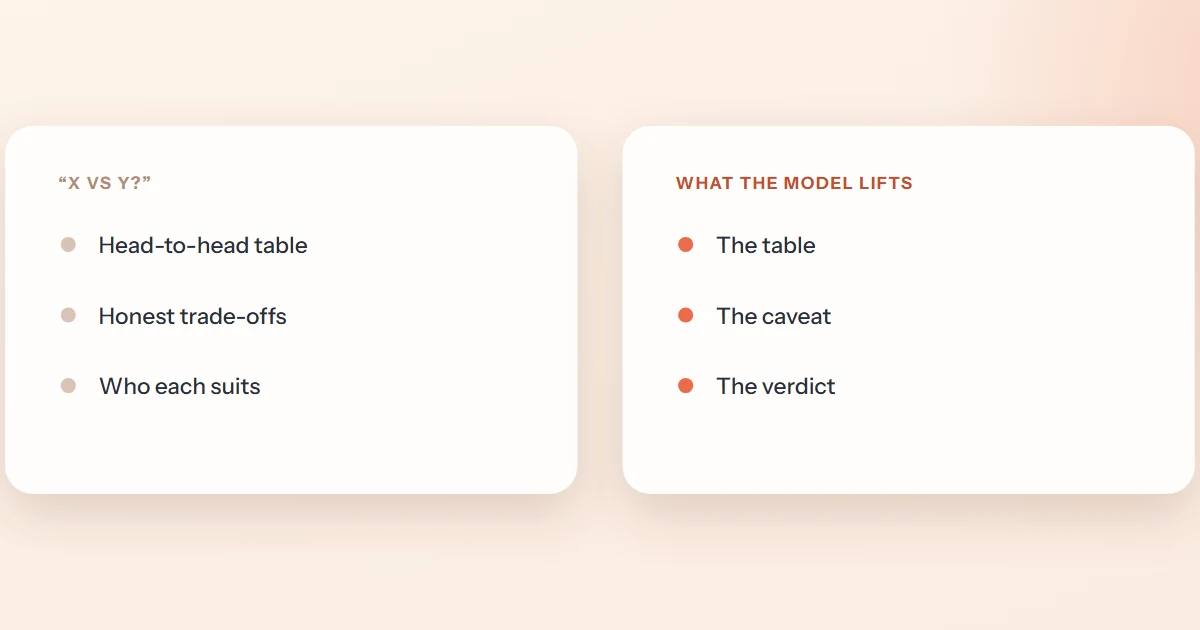
See it working: ask any assistant "[your product] vs [rival]" and look at the shape of the reply: a verdict, a criteria table, a segmented recommendation. That's the shape your page either feeds or forfeits. Our SaaS worked example — a composite, clearly labeled as such — shows comparison pages built to map onto the comparison prompts in a measurement suite; the comparison-page guide has the full pattern. Honesty is load-bearing here: a page that pretends the rival has no strengths reads as marketing, and models discount it.
Why engines reward it: comparison prompts ask for exactly this structure, and a page that already contains a fair verdict-plus-table is the lowest-effort source to synthesize from. It's also often the only substantive document about that specific matchup — in thin categories, the best comparison page isn't competing for the answer, it is the answer.
MentionBeat's free checker audits any page for the patterns on this list — answer-first structure, evidence density, schema, crawlability — and scores what an engine has to work with.
Run the free page audit5. Ship visible FAQs with matching FAQPage schema
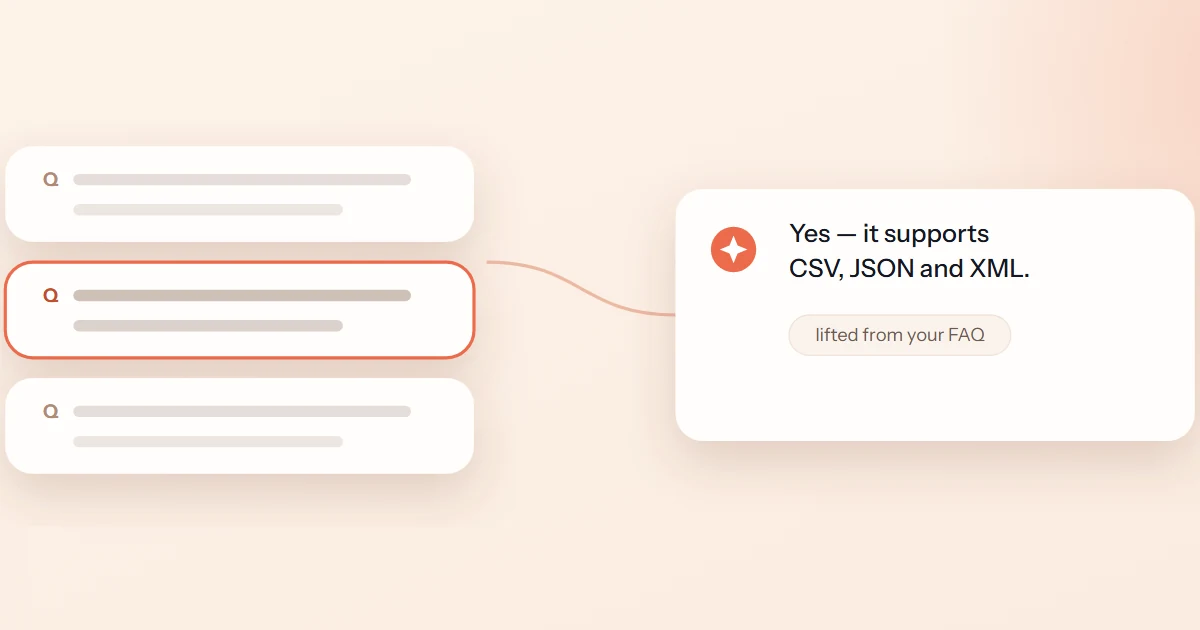
What to do: add an FAQ section that mirrors the questions buyers actually ask — pulled from sales calls and support tickets, not invented — and encode the same question–answer pairs as FAQPage JSON-LD so they're machine-legible as well as visible.
See it working: view source on this page. The FAQ below ships twice: once as visible HTML, once as a FAQPage script in the head, with identical wording. Every FAQ-bearing post on this blog does the same. If you want the markup without hand-writing it, the free schema builder generates FAQ, Product, Organization and Article JSON-LD from a form.
Why engines reward it: assistant queries are questions, and a Q&A block is content already shaped like the output. Google's guidance for AI features is that standard indexing and structured-data practices apply6 — schema doesn't buy placement, but it removes ambiguity about what your page asserts. FAQ content that engines lift straight into answers covers question selection, answer length and the traps.
6. Free your facts: crawlable HTML and an llms.txt
What to do: get every fact that should appear in answers — specs, pricing, compatibility, certifications — into server-rendered HTML. Out of PDF-only datasheets, out of JavaScript-rendered tabs, out from behind forms. Then add an llms.txt manifest pointing engines at your canonical pages.5
See it working: fetch Anthropic's llms.txt right now — a plain-markdown index of their entire API documentation, published by one of the companies that builds these engines.4 For the negative example, our industrial worked example diagnoses the classic failure: an instruments brand whose every spec lived in PDFs, invisible to retrieval pipelines chunking HTML. You can test your own site's crawler access — including CDN and firewall blocks robots.txt won't reveal — with the free AI access checker, and generate a manifest with the llms.txt generator.
Why engines reward it: retrieval can only verify what it can parse. An assistant answering a spec-constrained question drops vendors whose numbers it can't confirm in text — you don't lose on merit, you lose on legibility. This tactic has no percentage attached because it's not a lift, it's a gate: closed means invisible.
7. Get corroborated where engines already look
What to do: earn genuine presence — reviews, comparisons, community answers, reference entries — on the third-party sources engines cite in your category. Your own measurement tells you which domains those are; earn your way onto them rather than spraying mentions everywhere.
See it working: the clearest footprint is a price tag. Google pays Reddit a reported $60 million a year to license its content for AI training — a deal reported by Reuters in February 2024.2 Engines don't spend that on data they ignore. And in citation behavior, Semrush's three-month study of 230K prompts found Reddit and Wikipedia among the most-cited domains in AI answers — while also documenting how violently the mix churns, with ChatGPT's Reddit citation rate swinging from roughly 60% to around 10% inside six weeks.3
Why engines reward it: a claim that exists only on your domain is an assertion; the same claim echoed across independent sources reads as consensus, and consensus is what a risk-averse synthesizer repeats. Reddit, Wikipedia and the sources LLMs trust covers the big two; the third-party mentions guide covers earning the rest — authentically, because astroturfed corroboration is both against those communities' rules and increasingly detectable.
The pattern behind all seven
Every tactic above reduces the same quantity: the engine's risk of saying something it can't support. Answer-first passages are safe to quote. Statistics, citations and quotations are safe to assert. Honest comparisons are safe verdicts. FAQs are safe extractions. Crawlable facts are verifiable; corroborated facts are consensus. That's the whole discipline in one sentence — make your brand the lowest-risk thing an engine can say — and it's why "ranking" in AI search is earned with evidence rather than bought with volume.
What none of these tactics comes with is a guaranteed number. Effects vary by engine, category and time — the citation churn above is reason enough — so the only lift figure worth trusting is one measured on your own prompt suite, before and after, with confidence intervals. That's the loop: tactic, measurement, verdict, next tactic.
Frequently asked questions
Deliberately absent. Public before/after percentages in GEO content are almost never verifiable — you can't audit the prompt suite, the sample size or the time window behind them. The evidence here is a different kind: controlled research (the GEO study), documented industry facts (Google's Reddit deal), and public pages you can inspect yourself. For lift claims, trust only numbers measured on your own prompts with confidence intervals.
Measure first — a baseline tells you which tactic addresses your actual gap. If answers rarely mention you, start with comparison pages (tactic 4) and corroboration (tactic 7). If they mention you but describe you wrongly, fix your source pages (tactics 1–3 and 5). If engines can't crawl you at all (tactic 6), nothing else matters until access is fixed.
The mechanisms travel — every engine rewards content it can retrieve, verify and attribute. But engines retrieve from different indexes and cite different domains, and cited-source mixes shift over time,3 so the size of each tactic's effect varies by engine and category. Measure per engine rather than assuming a win transfers.
Sources & further reading
- Aggarwal, P., Murahari, V., Rajpurohit, T., Kalyan, A., Narasimhan, K., Deshpande, A. — "GEO: Generative Engine Optimization", KDD 2024 / arXiv:2311.09735.
- Search Engine Land — "Report: Reddit signs AI content licensing deal with Google" (reporting Reuters; ~$60M/year), February 2024.
- Semrush — "The Most-Cited Domains in AI: A 3-Month Study" (230K prompts, 100M+ citations across ChatGPT search, Google AI Mode and Perplexity, July–October 2025), November 2025.
- Anthropic — live llms.txt file for the Claude developer documentation (accessed August 2026).
- Answer.AI — "The /llms.txt file" proposal.
- Google Search Central — "AI features and your website".

Content Director at MentionBeat. Sofia turns retrieval research into editorial patterns — the page structures, passage formats and refresh cadences that earn citations from answer engines.