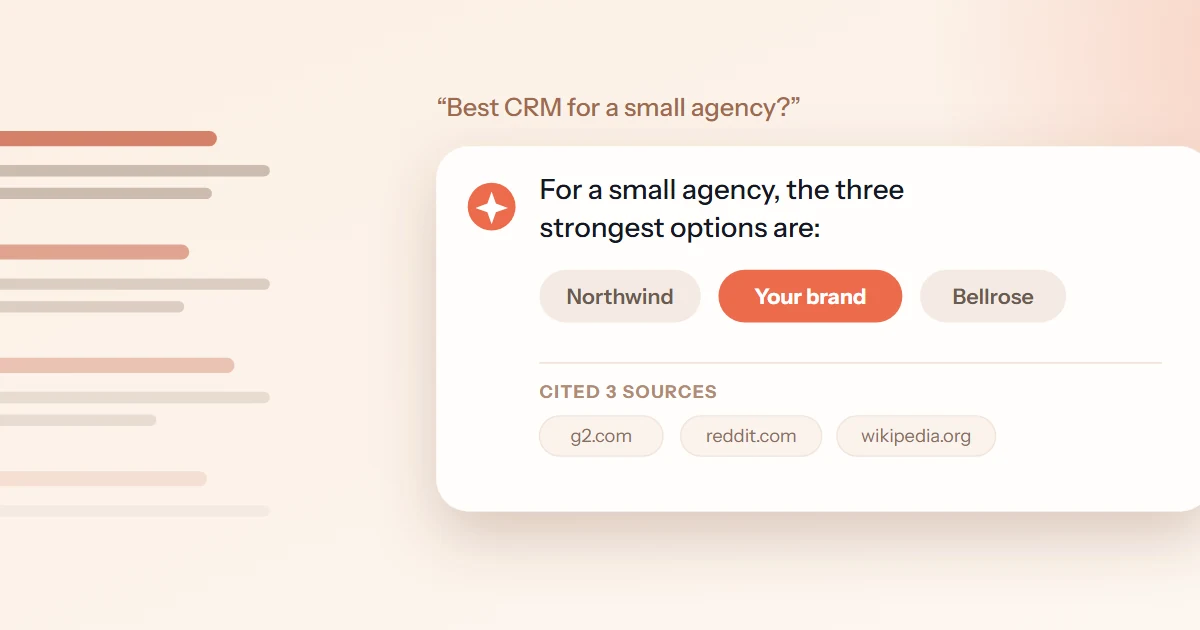
- There's no results page in AI search. Engines synthesize one answer and typically name two or three brands — "ranking" means being named, recommended and described accurately in it.
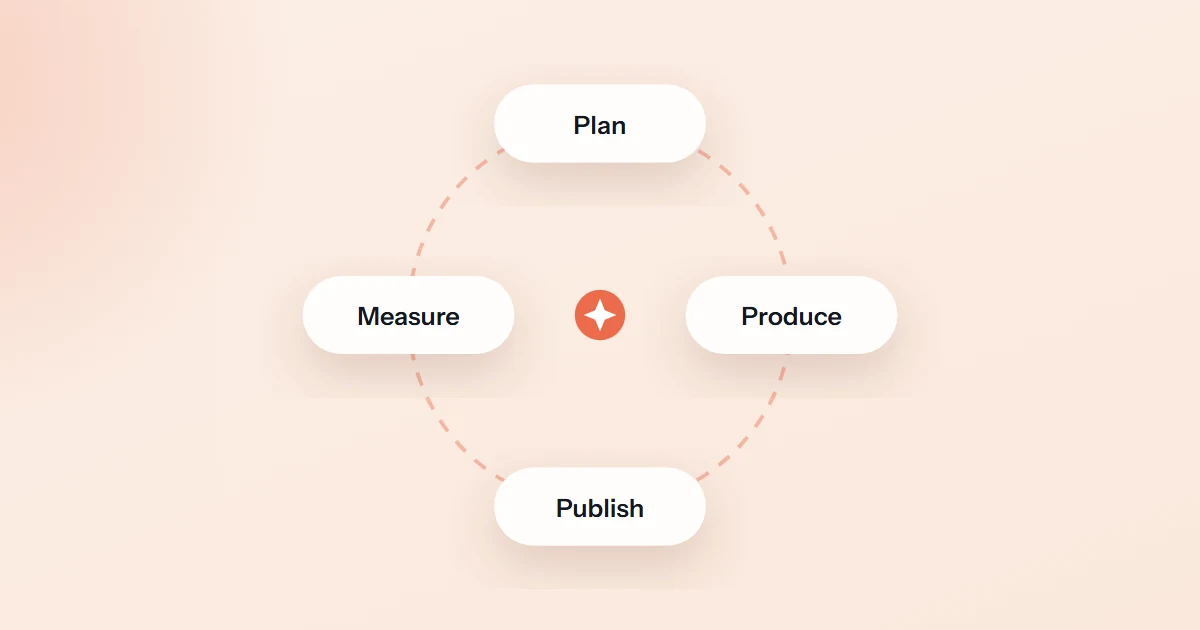
- The work is a loop, not a trick: measure → fix content → earn corroboration → stay retrievable → re-measure. Each step has a deep dive linked below.
- The content tactics that move visibility are measured, not folklore: adding citations, quotations and statistics lifted source visibility by up to ~40% in the GEO study.1
- Answers are stochastic and cited sources churn hard — one study watched ChatGPT's Reddit citation rate swing from ~60% to ~10% in six weeks.4 A baseline with confidence intervals, re-run on a cadence, is the only honest scoreboard.
Type a question into Google and you get a ranked list you can climb. Ask ChatGPT, Gemini or Perplexity the same question and you get a paragraph — confident, synthesized, naming two or three options. Nobody is #4 in a paragraph.
So the honest answer to "how do I rank in AI search?" starts with a correction: you don't rank — you get named. Either the answer mentions you, recommends you and gets your facts right, or your buyer shortlists someone else without ever seeing your site. The stakes are the same ones reshaping search overall: Gartner projected traditional search volume dropping 25% by 2026 as buyers shift to assistants,2 and Pew found Google users click a traditional result on only about 8% of visits when an AI summary appears, versus 15% without one.3
The good news: being named is earned, and the earning follows a repeatable loop. This guide is the map — each step summarized here, with the full deep-dive linked. If you want the conceptual version of the loop first, read the GEO flywheel; if you want the primer on the discipline itself, start with what is GEO.
Why there's no ranking to win
Every major assistant builds answers from two ingredients. Parametric knowledge is what the model absorbed in training — slow-moving brand associations formed from the public web. Retrieval is what it looks up at answer time: engines that browse fetch live pages, chunk them into passages, and synthesize an answer from the passages they trust. How ChatGPT decides which brands to recommend walks the mechanics in detail.
Neither ingredient produces a ranking. The model isn't ordering ten candidates; it's composing a short narrative and deciding which brands are safe to assert. "Safe" is the key word — a synthesizer leans on claims it can verify and attribute. That's why the levers below are about evidence and consensus, not keywords and positions.
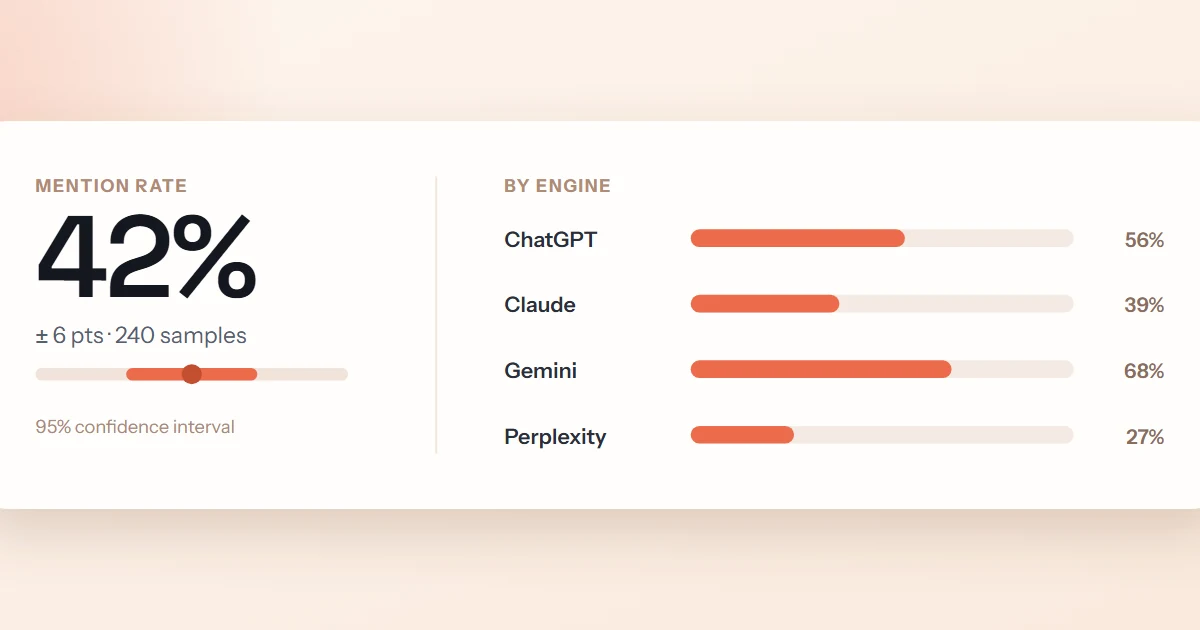
It also means your scoreboard changes. Instead of a position you check, you have a probability you sample: ask the same question ten times and you may appear in six answers, or two, or none. The metrics that replace rank are mention rate, recommendation rate and share of voice — computed across repeated runs, with confidence intervals, because single runs of a stochastic system are anecdotes.
Your SEO playbook, translated
If your team already does SEO well, you're not starting over — you're re-aiming. Here's the mapping (and the full comparison lives in GEO vs. SEO):
| What you'd do in SEO | What it becomes in GEO |
|---|---|
| Keyword research | A prompt suite: 20–50 questions phrased the way buyers actually ask assistants |
| Rank tracking | Repeated sampling of real answers — mention rate and share of voice with confidence intervals |
| On-page optimization | Answer-first, evidence-rich pages a model can quote and attribute |
| Link building | Corroboration: consistent mentions and descriptions on the sources engines cite |
| Technical SEO | AI crawler access, server-rendered HTML, schema, llms.txt |
| Chasing SERP features | Engine-by-engine answer surfaces — AI Overviews behave differently from chat assistants |
| Monthly rank report | Re-measured deltas against a fixed baseline on a metrics dashboard |
One SEO instinct transfers worst of all: keyword density. When the GEO study tested nine content tactics across ~10,000 queries, keyword stuffing did roughly nothing while evidence tactics won decisively.1 More on that in step 2.
The loop: five steps, repeated
Everything below is one turn of the flywheel — the closed loop that separates programs that compound from audits that plateau. Here's the practical version.
Step 1 — Measure where you actually stand
Start by building the instrument: a suite of 20–50 prompts that mirror how your buyers ask — discovery ("best X for Y"), comparison ("A vs B"), and problem-first questions pulled from sales calls and support tickets. Designing a prompt suite covers the craft; the short version is that the suite changes rarely and deliberately, because every change breaks your trend lines.
Then run it — each prompt, multiple times, on each engine you care about — and compute mention rate, recommendation rate and share of voice, plus accuracy: what the answers actually say about you. The repetition isn't pedantry. Answers vary run to run, so a rate without a confidence interval is a guess wearing a percentage sign. The baseline also doubles as a diagnosis: it shows you which competitors own your prompts, which engines you lag on, and which claims come back wrong.
If you want a first look before building any of this, the free checker gives you a one-shot read on where a page stands.
Step 2 — Fix your content so it's quotable
Models repeat what they can verify. The best-evidenced finding in the field comes from the GEO study (Aggarwal et al., KDD 2024): adding citations, quotations and statistics to a source lifted its visibility in generative answers by up to ~40%, while stylistic tricks did little.1 The content formats that win AI answers unpacks the study and shows the before/after edits.
Structurally, three page types do most of the work. Money pages should lead with a direct, self-contained answer and carry specific, sourced claims — the product page anatomy shows the pattern. Comparison pages map onto the "A vs B" prompts buyers actually ask. And FAQ sections that mirror real questions hand engines pre-packaged Q&A pairs. For a tour of these tactics with public, checkable examples, see 7 GEO tactics you can see working.
One more content job hides here: accuracy. If answers describe you with a stale product name or a rival's limitation, being mentioned can hurt. Fixing AI brand hallucinations covers how to trace a wrong claim to its source and correct it at the root.
Step 3 — Earn corroboration beyond your own domain
A claim that lives only on your website is, to a model, an assertion. The same claim echoed by review platforms, industry publications and community threads starts to look like consensus — and consensus is what a risk-averse synthesizer repeats. This is the GEO analogue of link building, except the currency is mentions and consistent descriptions, not anchor text.
Where to earn it isn't a mystery: engines lean hard on a recognizable set of sources, with Reddit and Wikipedia among the most-cited domains across platforms — though the mix churns constantly.4 Your measurement from step 1 tells you precisely which domains the answers in your category cite; earn presence there first. And make sure the entity itself is coherent: knowledge-graph and entity work keeps engines from confusing you with someone else.
MentionBeat runs real buyer prompts across ChatGPT, Claude, Gemini, Perplexity, Google AI Overviews and Grok, measures your mention rate and share of voice with confidence intervals, and turns the gaps into a fix queue.
Get a free visibility reportStep 4 — Stay retrievable
None of the above matters if engines can't read you. Retrieval rides on crawlers — GPTBot, ClaudeBot, Google-Extended and friends5 — and an old "temporary" block in robots.txt can quietly erase you from the fast loop. The AI crawler guide covers who to admit and why; the free AI access checker tests your origin against the real user agents, including the CDN and WAF blocks robots.txt won't show you.
Beyond access: keep facts in server-rendered HTML rather than behind JavaScript (most AI crawlers don't render it), keep specs out of PDF-only datasheets, ship structured data that matches your visible content, and consider an llms.txt manifest6 — the free generator builds one from your sitemap. This step is mostly one-time per page, which is exactly why teams forget to re-check it; put it on a quarterly cadence.
Step 5 — Re-measure, attribute, go again
Ship, wait for re-crawl and re-indexing, then re-run the identical suite and compare against your baseline — with intervals, so you can tell movement from noise. This is the step that turns tactics into a program: this cycle's measured gaps become next cycle's plan, which is the whole argument of the flywheel.
It's also the step the environment forces on you. Cited-source mixes swing violently — Semrush's three-month study of 230K prompts watched ChatGPT's Reddit citation rate collapse from roughly 60% to around 10% inside six weeks4 — and models retrain on their own schedules. A number from March is a memory by September. Content refresh covers keeping pages current; ROI and attribution covers connecting the movement to money, which is the conversation that keeps the program funded.
"OK, but how do I rank in ChatGPT?"
Same loop, sharper focus. ChatGPT blends trained associations with live retrieval through its search stack, and it cites what it can verify — so the levers are the ones above: quotable claims, corroboration on the sources it already cites, and crawler access for GPTBot and OAI-SearchBot.5 The ChatGPT deep dive covers the mechanics, and ChatGPT shopping covers the commerce surfaces.
Just don't stop there. Claude, Gemini, Perplexity and Google's AI Overviews retrieve differently and cite different sources — wins on one rarely transfer automatically. For AI Overviews specifically, you can check right now whether a page is cited for its target query. Measure per engine; fix where the numbers say you're weakest.
Frequently asked questions
Not inside the answer itself. Ads appear around some AI surfaces, but the synthesized answer is assembled from sources the engine trusts and retrieves. That's why the work is content, evidence and corroboration rather than media buying — and why no vendor can honestly guarantee you a mention.
The retrieval loop responds in days to weeks — engines that browse can cite a new page as soon as it's indexed. The training loop moves in months, tied to model release cycles. Most programs see measurable mention-rate movement within a quarter, faster in niche categories with thin source material.
There is no #1 — no positions exist inside a synthesized answer. The honest equivalent is a high mention rate and recommendation rate across repeated runs of your buyer prompts. Those are measurable and movable, but never guaranteed: nobody controls these engines, and anyone promising a ranking is promising something they can't deliver. That honesty test is also how we'd tell you to shop for a GEO vendor.
Mostly no. The fundamentals — answer-first structure, evidence, corroboration, crawlability — help everywhere. But engines retrieve from different indexes and cite different sources, so wins don't transfer automatically. Measure per engine and patch the gaps the numbers show you.
Sources & further reading
- Aggarwal, P., Murahari, V., Rajpurohit, T., Kalyan, A., Narasimhan, K., Deshpande, A. — "GEO: Generative Engine Optimization", KDD 2024 / arXiv:2311.09735.
- Gartner — "Gartner Predicts Search Engine Volume Will Drop 25% by 2026, Due to AI Chatbots and Other Virtual Agents", February 2024.
- Pew Research Center — "Google users are less likely to click on links when an AI summary appears in the results", July 2025.
- Semrush — "The Most-Cited Domains in AI: A 3-Month Study" (230K prompts, 100M+ citations across ChatGPT search, Google AI Mode and Perplexity, July–October 2025), November 2025.
- OpenAI — "Overview of OpenAI crawlers" (GPTBot, OAI-SearchBot); see also Anthropic's and Google's crawler documentation.
- Answer.AI — "The /llms.txt file" proposal.

GEO Strategy Lead at MentionBeat. Daniel helps teams turn visibility measurement into operating cadence — building the plan → produce → publish → measure loop inside marketing orgs of every size.