- Chegg's non-subscriber traffic went from −8% year over year in Q2 2024 to −49% by January 2025 — the steepest documented slide attributed to AI answers.1
- Q4 2024: revenue down 24%, subscribers down 21% to 3.6 million; in February 2025 Chegg sued Google over AI Overviews and said it was weighing a sale.2
- The mechanism is measurable, not mysterious: when an AI summary appears, users click a traditional result in 8% of visits vs 15% without one, and click the summary's own source links in about 1%.4
- The lesson isn't "AI kills traffic" — it's that substitution risk is a property of your business model, and it shows up in prompt-level data long before it shows up in revenue.
Most AI-visibility stories are anecdotes. Chegg is the exception: a public company whose collapse into the AI answer is documented quarter by quarter in earnings reports, executive statements and a federal lawsuit. That paper trail makes it the closest thing GEO has to a canonical case study — and the clearest illustration of which brands should be worried, and which shouldn't.
The documented timeline
Chegg sold homework help: step-by-step solutions and expert answers behind a subscription. Its acquisition funnel was organic search — a student googles a problem, lands on Chegg, hits the paywall. Then the answer started arriving before the click.
| When | What was reported | Source |
|---|---|---|
| Nov 2022 | ChatGPT launches; it can already answer many of the questions students paid Chegg for. | — |
| May 2023 | Chegg is among the first public companies to name ChatGPT as a headwind to new-account growth; the stock drops sharply on the disclosure. | Company earnings call2 |
| Q2 2024 | Non-subscriber traffic down a "modest" 8% year over year. | Chegg, per its complaint1 |
| Q4 2024 | Revenue down 24% year over year; subscribers down 21% to 3.6 million. | Q4 2024 results2 |
| Jan 2025 | Non-subscriber traffic down 49% year over year — the slide Chegg attributes to Google's expanding AI Overviews. | Chegg1 |
| Feb 24, 2025 | Chegg files an antitrust suit against Google over AI Overviews and announces it is exploring strategic alternatives, including a possible sale. Its share price sits roughly 90% below its 2021 peak. | CNBC, Tech Startups2,3 |
The phrase worth keeping from the lawsuit: Chegg argues Google has transformed from a search engine — which sends visitors on — into an answer engine that consumes third-party content and keeps the visitor.1 Whatever the court makes of that, it is precisely the shift every consideration-driven brand now has to measure.
The mechanism, measured independently
Chegg's account might sound self-serving — a struggling company blaming the platform. But the mechanism it describes has been measured by third parties with no stake in the lawsuit:
- Pew Research Center (68,879 real Google searches from 900 U.S. adults, March 2025 data): when an AI Overview appears, users click a traditional result in 8% of visits, versus 15% when there's no summary. Links inside the AI summary get clicked in about 1% of visits — and users end their session entirely 26% of the time after seeing a summary, versus 16% without.4
- Ahrefs (April 2025): comparing informational keywords with and without AI Overviews, the presence of an AI Overview correlated with a 34.5% lower average click-through rate for the top-ranking page.5
Read those two studies together and Chegg's trajectory stops looking anomalous. A business whose entire funnel was "rank, get the click, convert at the paywall" was exposed to exactly the click that disappeared.
Substitution vs referral: which side are you on?
The Chegg lesson is routinely over-generalised into "AI search destroys traffic." That's not what the data says. The determining variable is where your value sits relative to the answer:
| Substitution exposure | Referral opportunity | |
|---|---|---|
| Your product is… | the answer itself (solutions, summaries, reference content) | behind the answer (software, services, physical goods) |
| When the engine answers well… | the buyer's need is met without you | the buyer still needs to buy — from whoever was named |
| Being cited means… | little — your content was consumed, the visit wasn't | a lot — you're the recommendation the buyer acts on |
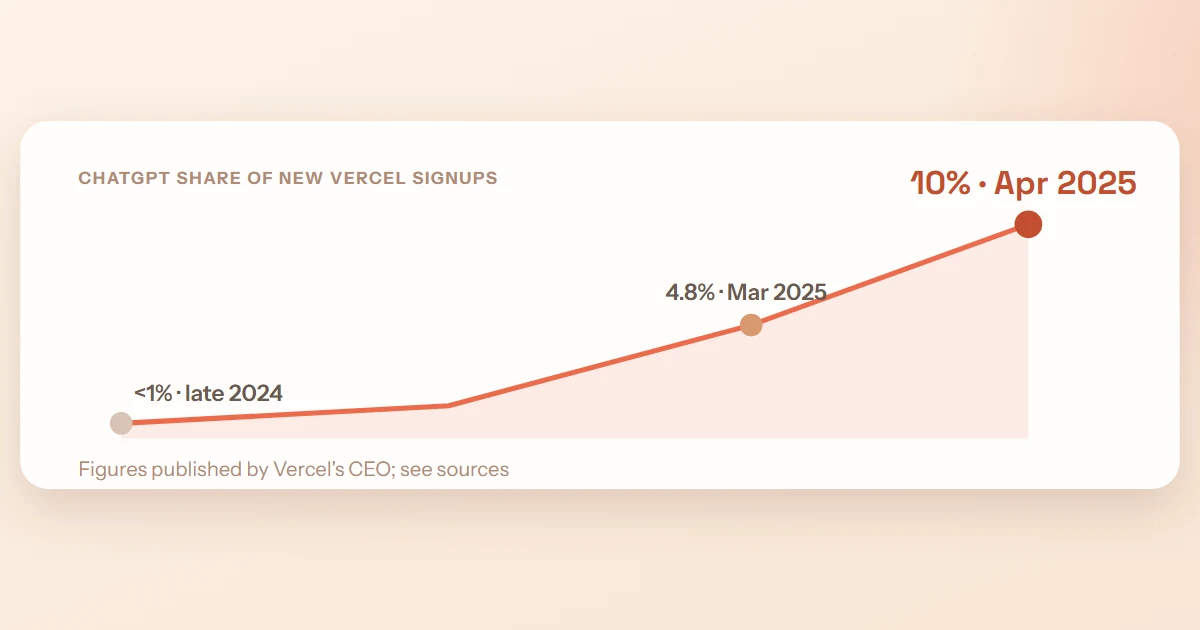
| Documented example | Chegg | Vercel — 10% of new signups from ChatGPT |
Chegg sat at the far substitution end: the model could produce its product. If your buyers ask assistants which tool, provider or product to choose — rather than asking the assistant to be the product — the same shift that broke Chegg's funnel is the one that can send you buyers who never see a results page. That's the case we examine in the companion pieces on the zero-click buyer journey and AI referral traffic.
What a measurement program changes
It's tempting to conclude nothing could have helped — and honestly, no GEO tactic would have restored Chegg's old funnel. What measurement changes is when you know and what you know:
- You see substitution at the prompt level, quarters early. The share of your category's buyer questions that engines answer fully — without naming or citing anyone — is measurable today, prompt by prompt. That number moving is the leading indicator; traffic and revenue are the lagging ones.
- You separate the two risks. Falling clicks with rising mentions is a very different problem (and opportunity) from falling clicks with falling mentions. Without mention and citation tracking, both look identical in analytics: less traffic.
- You know whether you're cited or consumed. An engine can use your content and never send the visit — Pew's 1% source-click figure quantifies exactly that.4 Knowing which of your pages engines actually draw on is the difference between a content strategy and a donation.
A two-minute version of that check exists as a free tool: run a search your buyers actually make through the AI Overview checker and see who Google's answer cites — and whether it's you.
Frequently asked questions
Not on its own. When a model can produce your product's core value directly, no optimization tactic restores the old traffic. What measurement buys is time and clarity: the substitution shows up in prompt-level data long before it reaches an earnings report, while there are still strategic options — repositioning, product change, distribution deals — that are much harder to execute in year three of the slide.
No. Chegg's product was the answer, so a good AI answer replaced it. A brand whose product sits behind the answer — software, services, goods — can gain from the same shift, because being named and recommended sends buyers to it. Map your own prompts before assuming either story applies to you.
Prompt-level substitution: the share of your category's buyer questions engines now answer fully without citing or naming anyone, tracked alongside your own mention and citation rates and your AI-referral mix. Those move quarters before revenue does — which is the entire argument for measuring AI visibility on a schedule rather than checking it once.
Sources
- MediaPost — "Chegg Sues Google, Alleges AI Overviews Destroyed Its Website Traffic", February 25, 2025 — including the −8% (Q2 2024) and −49% (January 2025) non-subscriber traffic figures from Chegg's complaint and executive commentary.
- CNBC — "Chegg sues Google for hurting traffic with AI as it considers strategic alternatives", February 24, 2025; Q4 2024 revenue −24% and subscribers −21% to 3.6M per EdTech Innovation Hub's summary of Chegg's Q4 2024 results.
- Tech Startups — "Chegg sues Google, blames AI-generated summaries for traffic loss, falling revenue, and 90% stock crash", February 25, 2025.
- Pew Research Center — "Google users are less likely to click on links when an AI summary appears in the results", July 22, 2025. 900 U.S. adults, 68,879 searches, March 2025 data.
- Ahrefs (Ryan Law) — "AI Overviews Reduce Clicks by 34.5%", April 2025.

Head of Research at MentionBeat. Maya leads the measurement methodology behind MentionBeat's visibility metrics — prompt-suite design, sampling, and confidence intervals — and writes about how generative engines choose what to say.